
Getting a stepped outline ready in PowerPoint or Canva can mean arranging rectangles, covering unwanted edges and nudging dimension labels before the lesson itself is ready. A maths diagram tool for teachers gives that construction work a dedicated home. In Zairoo.Ai Free Pad, shape, Slice, Text and Length Arrow controls bring the figure and its annotations into one maths workspace. You can concentrate on preparing a usable drawing rather than treating every label as another slide element to tidy. Keep the checked figure as your starting point for the question, explanation and later teaching material.
Build the composite outline where the maths belongs
A corner cutout needs more than a rectangle with a number beside it. Its outline, recessed edges and dimension arrows all need a place. Free Pad brings Rectangle, Slice, a grid and Layers into the same workspace, so you can organise that construction without repeatedly returning to a general slide layout. Text and Length Arrow controls give the measurements a clear role beside the shape. The practical benefit is a focused place to prepare the figure you actually need, rather than another round of arranging unrelated objects for each lesson.
Keep a usable figure for the next teaching job
Once the outline is ready, the drawing can become a reusable teaching asset rather than a one-off slide. PNG and SVG export give you options for placing it in existing materials, with an optional transparent background when that suits the page. Your teacher check of the dimensions and labels makes the exported figure a dependable starting point. Keep that version for the worked explanation or a later handout, so more of your preparation goes into what pupils will notice and less into rebuilding the same corner and arrows.
Plan the figure before choosing a tool
If you prepare diagrams in a document or slide editor, one possible method is to assemble rectangles, remove unwanted lines and add dimensions. For either approach, use the same brief: an outer rectangle 16 cm wide and 12 cm high, with a 5 cm wide, 4 cm high rectangle removed from its top-right corner.
The resulting six-edge outline has a top edge of 11 cm, an inward vertical edge of 4 cm, an inward horizontal edge of 5 cm and a right edge of 8 cm. Its bottom and left edges remain 16 cm and 12 cm. Keep width horizontal and height vertical throughout; swapping the cutout dimensions changes the figure.
Construct and check in Free Pad
Open Free Pad from the Diagram navigation. Use Choose Shape and a grid background to organise the figure, then add dimensions with Length Arrow and Text. Begin with the enclosing width and height before checking the inward step. Work around the outline in one direction so each edge has a clear place in your dimension plan.
Choose a grid background as a visual alignment aid, but do not treat a grid square as one centimetre unless you have explicitly established that scale. Check that opposite horizontal spans reconcile and that vertical spans reconcile. Move labels away from corners so a pupil can identify which edge each value describes. The P4 rectangles and squares guide supports the prerequisite discussion of opposite sides, right angles and grid units.
Original classroom question
A rectangular card measures 16 cm by 12 cm. A rectangle measuring 5 cm horizontally and 4 cm vertically is removed from the top-right corner. Adjacent boundary edges are perpendicular. Find the remaining top length, the remaining right length, the area of the card and its perimeter.
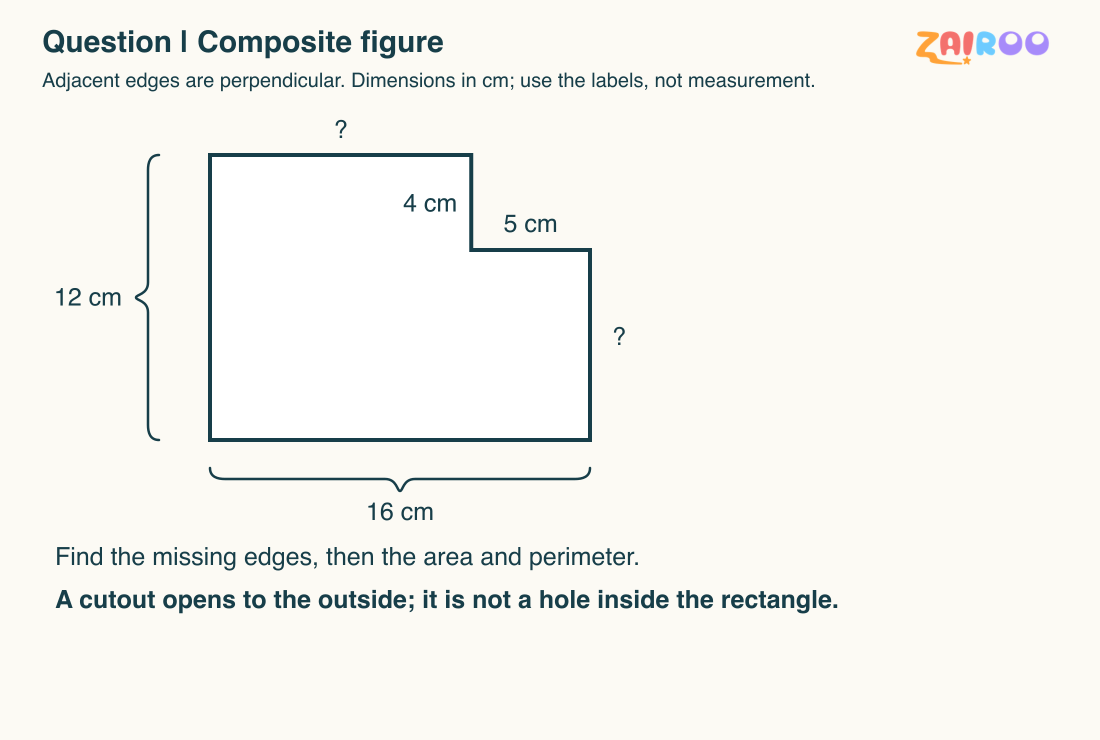
The question gives the enclosing rectangle and the size of the removed corner. The two remaining edge lengths follow from matching horizontal and vertical spans.
Worked solution and independent check
16 - 5 = 11 cm: remaining top length.
12 - 4 = 8 cm: remaining right length.
16 x 12 = 192 cm squared: enclosing rectangle.
5 x 4 = 20 cm squared: removed corner.
192 - 20 = 172 cm squared: remaining area.
11 + 4 + 5 + 8 + 16 + 12 = 56 cm: six boundary edges.
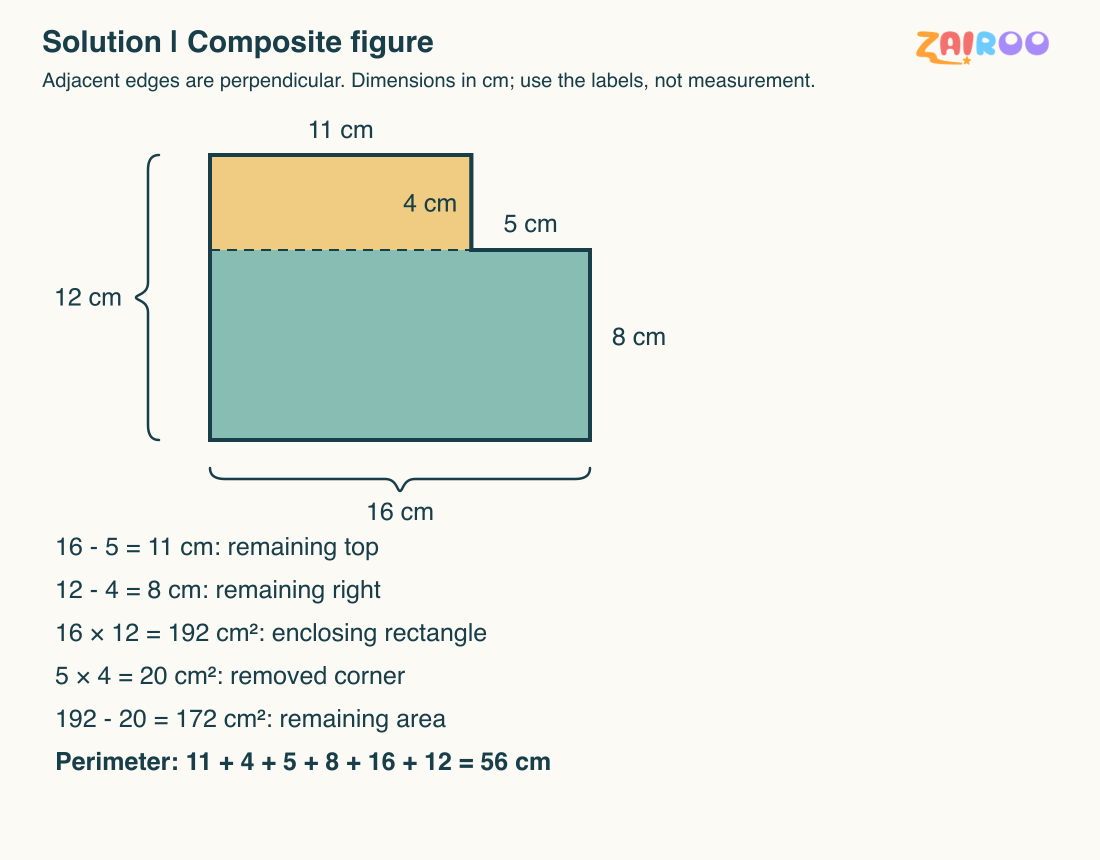
The horizontal split separates a full-width lower rectangle from an upper-left rectangle. Together they cover the remaining card without overlap.
16 x 8 = 128 cm squared: lower rectangle in the independent split.
11 x 4 = 44 cm squared: upper-left rectangle.
128 + 44 = 172 cm squared: agrees with subtraction.
2 x (16 + 12) = 56 cm: independent perimeter check.
Questions that test the drawing
Ask: Which two horizontal lengths rebuild the full width? Why is the internal split absent from the perimeter? Would removing a deeper corner always change this perimeter? The P4 area and perimeter guide provides context for splitting composite rectangles and tracing only the outside boundary. Here, the cutout replaces equal horizontal and vertical lengths, so the perimeter matches the enclosing rectangle.
Fresh retry
Use an 18 cm by 11 cm card with a top-right corner 6 cm wide and 3 cm high removed. Find the two missing edges, area and perimeter.
18 - 6 = 12 cm: remaining top.
11 - 3 = 8 cm: remaining right.
18 x 11 = 198 cm squared: enclosing area.
6 x 3 = 18 cm squared: removed area.
198 - 18 = 180 cm squared: remaining area.
12 + 3 + 6 + 8 + 18 + 11 = 58 cm: perimeter.
From drawing to teaching material
Free Pad's Export menu offers Download SVG and Download PNG, with an optional Transparent background. Export the figure, then manually place it in a separate document editor if you need a handout. Add the question and working space there. Read the dimensions at the final page size: a clear enlarged drawing can become difficult to interpret after reduction.
Before class, trace the outline without looking at the calculations. Every turn should correspond to a corner in the question. Then cover the solution and explain how each missing length follows from a whole span. This rehearsal helps you spot a misplaced dimension arrow before pupils encounter it.
Preparation FAQ
Should I start with shading? Establish the boundary and dimensions first. Add region shading when discussing area, so it supports a mathematical decision rather than obscuring an edge.
How do I request educator access? Email business@zairoo.ai for a Free Pad demo, including your teaching level and diagram task, without pupil personal information. For families seeking homework support instead, explore the parent platform; this is separate from educator demo access.
How Zairoo primary maths practice works
Explore the parent practice routine, topic selection and progress information.