
An exterior-angle question can leave you spending more effort separating tiny arcs and vertex labels in Canva than preparing the explanation. A geometry diagram tool for teachers should bring that preparation back to the figure. Zairoo.Ai offers Free Pad for custom-authored drawings and Geometry Angle Solver for supported angle problems. This gives you a dedicated maths workspace instead of making every geometry lesson another slide-construction exercise. Whether you need a particular triangle or a supported practice figure, the aim is a readable teaching asset that leaves you free to plan the discussion around it.
Give custom angle figures a dedicated drawing space
For this triangle and extended baseline, Free Pad is the place to author the required figure. Text and Angle controls keep the annotations close to the drawing task, while Layers help organise its elements. Preparing the figure there means the geometry has its own working space before you place it in your presentation. You can build a question view and an explanation from the same specification instead of repeatedly positioning the triangle, extension and labels as separate design jobs. The benefit is a reusable figure with a clear teaching purpose.
Prepare supported angle cards with readable labels
Geometry Angle Solver offers a different route for supported problems: choose an outer shape and use Generate5 to produce five problem cards. Move Label, Rename Label and Angle Arc Size let you attend to how the labels read. Your teacher check of the conditions and answers turns the selected card into a considered lesson choice. These controls make angle preparation more focused, whether you are selecting a practice problem or refining its presentation. Custom construction stays in Free Pad, while supported cards provide another practical starting point within the portal.
Make the conditions visible
Use triangle ABC with B on the left, C on the right and A above the base. Extend BC through C to D, so B, C and D lie on one straight line in that order. State that angle BAC is 48 degrees and angle ABC is 67 degrees. Ask for interior angle ACB, then exterior angle ACD.
This is an original P5 question, not an official examination item. No equal-side or parallel-line condition is given. Do not add matching side marks just to make the diagram look balanced: those marks would introduce a condition that the question does not contain. Position the interior and exterior target labels on opposite sides of ray CA, with enough space to distinguish them.
Prepare the figure and review its labels
Construct the teaching figure in Free Pad and show the base extension clearly. Prepare a separate explanation view so pupils can first identify the two target angles without seeing the answers. Keep A, B, C and D in the same positions in both views; otherwise a change in orientation can distract from the angle relationship.
Geometry opens Angle Solver, where Generate5 produces five problems. When inspecting a supported angle figure, use Move Label, Rename Label and Angle Arc Size to review readability. Examine which vertex each label belongs to and whether an arc sits inside or outside the triangle. Check the mathematics of each problem before using it with your class.
Use the Free Pad construction for the exact triangle-and-extension question below. A different Geometry problem can provide a comparison discussion, but first identify its own givens and target. Two similar-looking figures may require different angle facts when their straight lines, equal sides or parallel conditions differ.
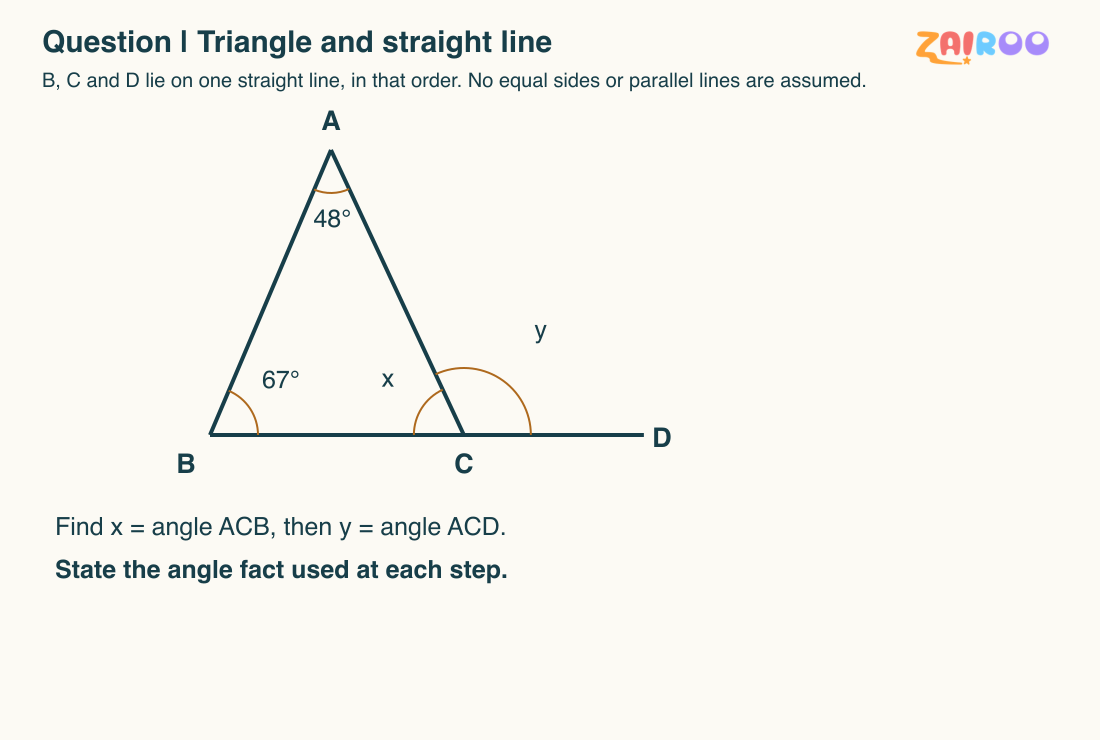
At C, the interior target lies between CA and CB. The exterior target lies between CA and CD, on the other side of CA.
Original question and worked reasoning
Triangle ABC has angle BAC of 48 degrees and angle ABC of 67 degrees. Side BC is extended through C to D. Find angle ACB and angle ACD. Give the angle fact used at each step, and explain why the two angles at C are not both interior triangle angles.
48 + 67 = 115 degrees: sum of the two given interior angles.
180 - 115 = 65 degrees: angle ACB, using the triangle angle sum.
180 - 65 = 115 degrees: angle ACD, using adjacent angles on straight line BCD.
The P5 triangles guide supplies the triangle-sum prerequisite. The P5 angles guide supports the straight-line relationship. Use the fact attached to the actual figure, rather than choosing 180 or 360 because it appears in a memorised list.
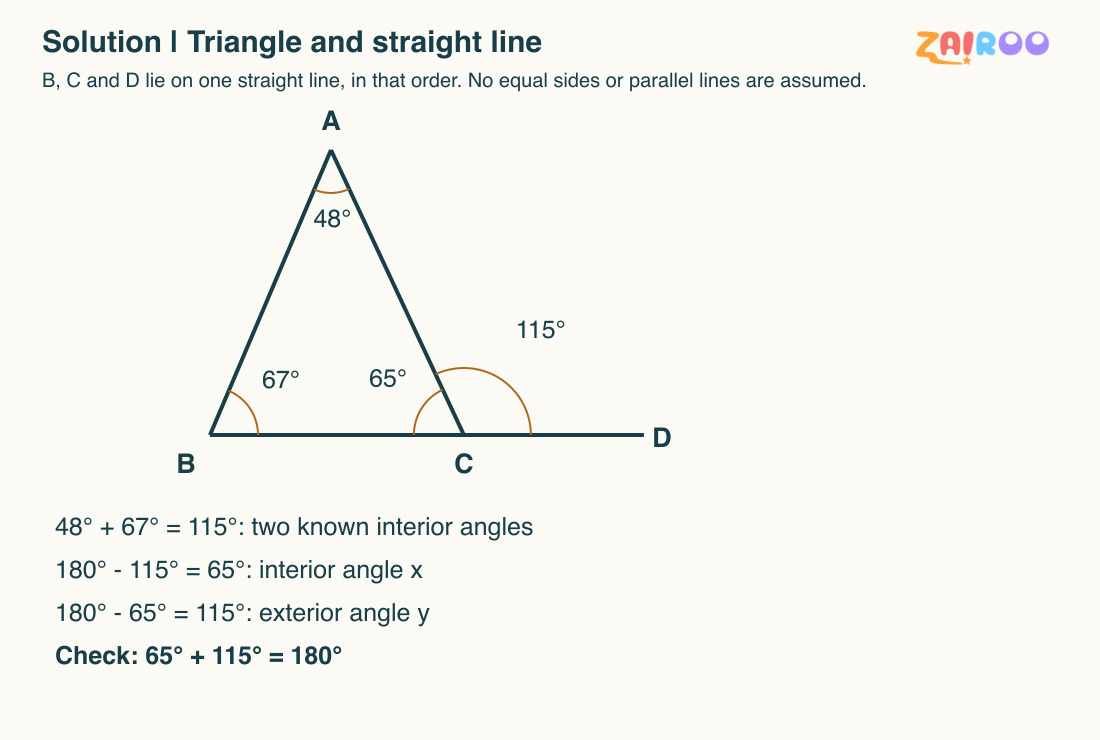
The two angles at C complete a straight angle. Only the 65-degree angle belongs to the triangle's interior.
Independent checks and teacher questions
48 + 67 + 65 = 180 degrees: all three interior angles satisfy the triangle sum.
65 + 115 = 180 degrees: the two adjacent angles at C make a straight angle.
All angles are positive, and the three interior angles are below 180 degrees. Ask: Which rays enclose angle ACD? What would be missing if D were not stated to lie on the extension? Why does the exterior angle happen to equal the sum of the two given interior angles? Let pupils justify that last relationship through the two steps before using it as a shortcut.
Fresh retry
In a new triangle ABC, angle BAC is 52 degrees and angle ABC is 59 degrees. Extend BC through C to D again. Find the same two targets and name each reason.
52 + 59 = 111 degrees: sum of the given angles.
180 - 111 = 69 degrees: interior ACB by triangle sum.
180 - 69 = 111 degrees: exterior ACD by the straight line.
52 + 59 + 69 = 180 degrees: independent interior check.
Preparation FAQ
Should pupils measure the drawing? No: the givens and stated relationships determine the answers. What should I check before sharing the drawing? Read every three-letter angle name from its middle vertex, then point to both bounding rays. Export the Free Pad figure with Download PNG or Download SVG and manually place it in your separate lesson document if needed.
Email business@zairoo.ai to request an educator Geometry demo with an anonymised angle task. For families seeking homework support, explore the parent platform, which is separate from educator demo access.
How Zairoo primary maths practice works
Explore the parent practice routine, topic selection and progress information.