One drawing can support a worthwhile session
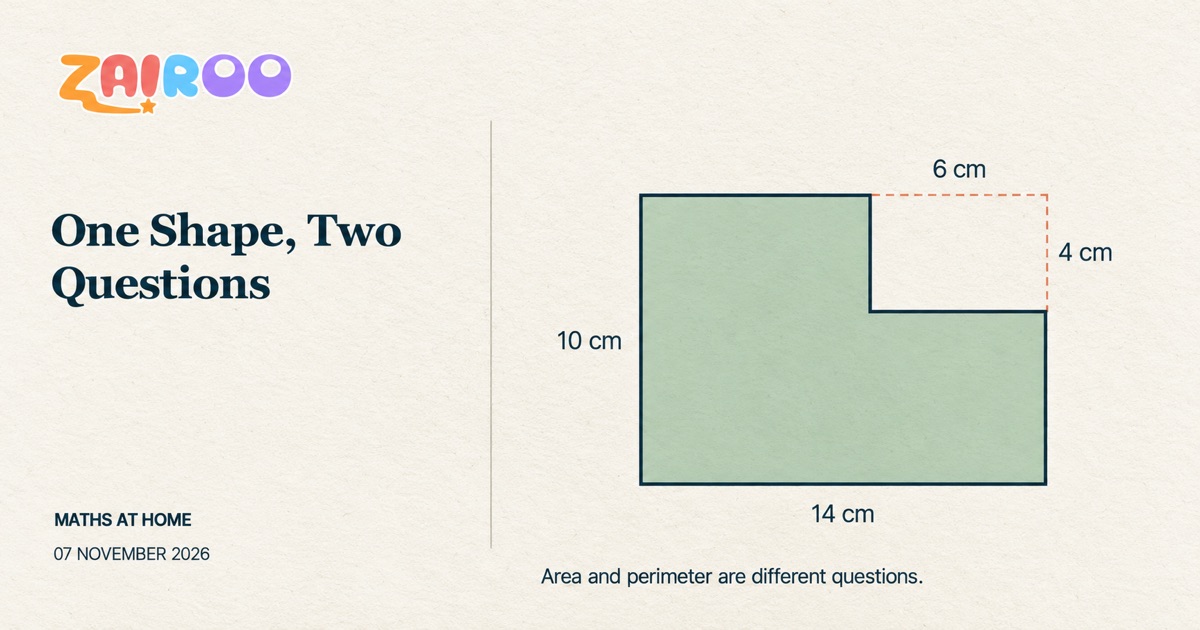
For an L-shaped figure made by removing a corner rectangle, find the area by subtraction and the perimeter by tracing the remaining boundary. These are different tasks: area measures the surface covered, while perimeter measures the distance around its edge.
For a holiday activity with Zairoo.Ai, one carefully discussed shape can be enough to begin. This challenge suits P4 learners who know rectangle area, perimeter, multiplication and subtraction. They should also recognise the difference between centimetres and square centimetres. No algebra is needed.
Define the shape before calculating
Draw an outer rectangle 14 cm wide and 10 cm high. Keep its sides horizontal and vertical. From its top-right corner, remove a smaller rectangle 6 cm wide and 4 cm high, with the small rectangle's top and right edges on the outer rectangle's edges.
The remaining shape is an L. Its bottom edge is still 14 cm and its left edge still 10 cm. The top horizontal edge left after the cut is 14 - 6 = 8 cm. The lower right vertical edge is 10 - 4 = 6 cm.
The inward horizontal notch is 6 cm long, matching the width of the cutout. Its inward vertical edge is 4 cm long, matching the cutout's height. Label all six boundary edges; do not rely on how long a rough sketch happens to look.
The P4 area and perimeter guide covers the relevant composite-shape ideas. The word-problem methods guide is a useful companion when deciding what to label before choosing a calculation.
Visual model and step by step solution
Step 1 Find the remaining area
Outer area: 14 x 10 = 140 cm²
Removed area: 6 x 4 = 24 cm²
140 - 24 = 116 cm²
Step 2 Label the two shorter outer edges
Top edge: 14 - 6 = 8 cm
Lower right edge: 10 - 4 = 6 cm
Step 3 Trace all six boundary edges
14 + 6 + 6 + 4 + 8 + 10 = 48 cm
Answer: Remaining area = 116 cm². Perimeter = 48 cm.
Check against the question
Lower rectangle: 14 x 6 = 84 cm²
Upper rectangle: 8 x 4 = 32 cm²
84 + 32 = 116 cm²
Outer perimeter: 2 x (14 + 10) = 48 cm
A misconception worth exploring
A child may subtract the cutout's perimeter from the outer perimeter. Ask them to trace where a fence would now go. Two edges of the cutout become new exposed boundaries, so subtraction alone misses them.
Another common mix-up is writing 116 cm for the area. Ask whether the answer counts unit squares or measures a line. The drawing should support that distinction rather than becoming just a place to collect numbers.
Parent prompts
Ask, "Which lines are still on the outside after the corner is removed?" Then, "Can you split the remaining space into rectangles with no overlap?" For a check, ask, "Does your route return to its starting point without skipping an edge?"
Keep the first drawing free of answers while your child labels it. A second copy can hold the checking method.
Fresh retry with a worked solution
A 16 cm by 12 cm rectangle has a 5 cm wide, 3 cm high rectangle removed from its top-right corner. Find the remaining area and perimeter.
Pause for an independent attempt before reading the model and solution.
Step 1 Find the remaining area
Outer area: 16 x 12 = 192 cm²
Removed area: 5 x 3 = 15 cm²
192 - 15 = 177 cm²
Step 2 Label the two shorter outer edges
Top edge: 16 - 5 = 11 cm
Lower right edge: 12 - 3 = 9 cm
Step 3 Trace all six boundary edges
16 + 9 + 5 + 3 + 11 + 12 = 56 cm
Answer: Remaining area = 177 cm². Perimeter = 56 cm.
Check against the question
Lower rectangle: 16 x 9 = 144 cm²
Upper rectangle: 11 x 3 = 33 cm²
144 + 33 = 177 cm²
Outer perimeter: 2 x (16 + 12) = 56 cm
A multi step extension
A rectangular display board has perimeter 64 cm and length 20 cm. A rectangle of area 36 cm² and height 6 cm is removed from its top-right corner, with its top and right edges on the original boundary. Find the remaining area and perimeter. All edges are horizontal or vertical.
Step 1 Find the missing outer height
64 / 2 = 32 cm
32 - 20 = 12 cm
Step 2 Find the cutout width
36 / 6 = 6 cm
Step 3 Find the remaining area
Outer area: 20 x 12 = 240 cm²
Removed area: 6 x 6 = 36 cm²
240 - 36 = 204 cm²
Step 4 Label the two shorter outer edges
Top edge: 20 - 6 = 14 cm
Lower right edge: 12 - 6 = 6 cm
Step 5 Trace all six boundary edges
20 + 6 + 6 + 6 + 14 + 12 = 64 cm
Answer: Remaining area = 204 cm². Perimeter = 64 cm.
Check against the question
Lower rectangle: 20 x 6 = 120 cm²
Upper rectangle: 14 x 6 = 84 cm²
120 + 84 = 204 cm²
Outer perimeter: 2 x (20 + 12) = 64 cm
Extension retry with a worked solution
A rectangle has perimeter 72 cm and length 22 cm. A top-right rectangular cutout has area 40 cm² and height 5 cm. Find the remaining area and perimeter.
Try this independently before checking the solution.
Step 1 Find the missing outer height
72 / 2 = 36 cm
36 - 22 = 14 cm
Step 2 Find the cutout width
40 / 5 = 8 cm
Step 3 Find the remaining area
Outer area: 22 x 14 = 308 cm²
Removed area: 8 x 5 = 40 cm²
308 - 40 = 268 cm²
Step 4 Label the two shorter outer edges
Top edge: 22 - 8 = 14 cm
Lower right edge: 14 - 5 = 9 cm
Step 5 Trace all six boundary edges
22 + 9 + 8 + 5 + 14 + 14 = 72 cm
Answer: Remaining area = 268 cm². Perimeter = 72 cm.
Check against the question
Lower rectangle: 22 x 9 = 198 cm²
Upper rectangle: 14 x 5 = 70 cm²
198 + 70 = 268 cm²
Outer perimeter: 2 x (22 + 14) = 72 cm
FAQs
Must the sketch be to scale? No, but all dimensions and the corner position must be unambiguous.
Can we find only the area today? Yes. Save the perimeter question for another session if needed.
Source note: Both shapes are original practice challenges, not official exam questions.
Continue with Zairoo.Ai, and let your child choose whether their next explanation follows the surface or the boundary.