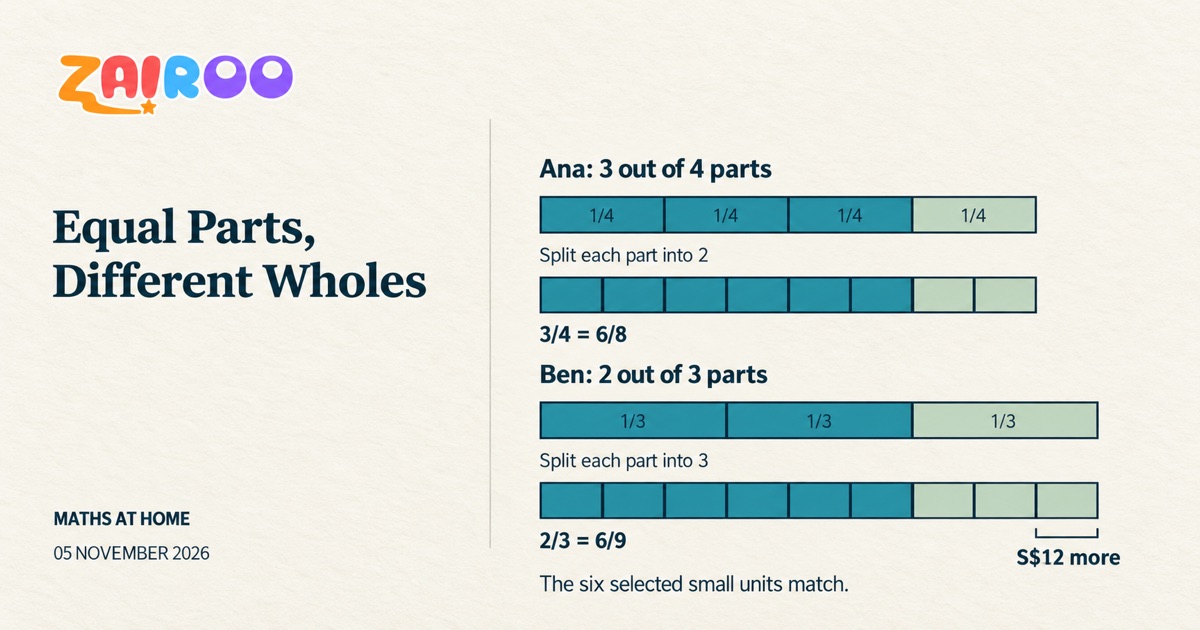
Make the equal amount visible
When a fraction of one person's money equals a fraction of another person's money, start with the amount they share. Divide that shared value into equal-sized pieces that work for both fractions. This gives you a way to compare the original amounts without guessing.
If your family uses Zairoo.Ai, a labelled paper model can keep the explanation clear. This challenge suits P5 learners familiar with equivalent fractions, fractions of quantities and equal-part bars. We will use those ideas without introducing formal ratio notation.
The challenge
Three quarters of Ana's money equals two thirds of Ben's money. Ben has S$12 more than Ana. How much does each child have? What is the value of the equal fractional amounts?
The common amount is not either child's whole amount. Ana's whole is divided into quarters; Ben's whole is divided into thirds. Their fraction labels describe different starting amounts, even though the selected portions have the same value.
The P5 fractions guide provides relevant fraction background. The P5 methods and model-drawing guide gives context for using parts to represent money relationships.
Visual model and step by step solution
Step 1 Build genuinely equal small units
Three quarter-parts of Ana's money equal two third-parts of Ben's money.
Split each selected Ana quarter-part into 2 small units.
Selected Ana portion: 3 x 2 = 6 small units
Split each selected Ben third-part into 3 small units.
Selected Ben portion: 2 x 3 = 6 small units
The two selected portions have equal value and the same number of small units, so those units are equal.
Ana whole bar: 4 x 2 = 8 small units
Ben whole bar: 3 x 3 = 9 small units
Step 2 Find one common unit
9 - 8 = 1 unit
12 / 1 = S$12
Step 3 Find both whole amounts
Ana: 8 x 12 = S$96
Ben: 9 x 12 = S$108
Step 4 Find the equal selected amount
6 x 12 = S$72
Answer: Ana has S$96; Ben has S$108. The equal portion is S$72.
Check against the question
108 - 96 = S$12
6/8 x 96 = S$72
6/9 x 108 = S$72
The misconception to watch for
A child may draw four boxes for Ana and three for Ben, then assume every box has the same value. That would make Ana have more, which contradicts the stated difference.
The cross-denominator step is not an instruction to multiply every visible number at random. We split the three selected Ana parts into pairs and the two selected Ben parts into threes so both equal portions contain six common pieces. Always explain why the pieces can now match.
For the same whole, three quarters is greater than two thirds. Here the whole amounts differ; the equality describes selected quantities, not an assertion that the fraction numbers themselves are equal.
Parent prompts without the answer
Ask, "Which two portions must have the same value?" Then, "Could you split those equal portions into the same number of smaller pieces?" Finally, "Where can you show the difference between the complete bars?"
If your child proposes unequal small pieces, ask them to justify the matching. Let them adjust the drawing before discussing money values.
Fresh retry with a worked solution
Two thirds of Cara's money equals half of Dan's money. Dan has S$18 more than Cara. Find both whole amounts and the equal selected amount.
Pause for an independent attempt before reading the model and solution.
Step 1 Build genuinely equal small units
Split the equal selected amount into 2 small units in each bar.
Cara's two selected third-parts are 1 small unit each.
Cara whole bar: 3 x 1 = 3 small units
Dan's selected half is 2 small units.
Dan whole bar: 2 x 2 = 4 small units
Step 2 Find one common unit
4 - 3 = 1 unit
18 / 1 = S$18
Step 3 Find both whole amounts
Cara: 3 x 18 = S$54
Dan: 4 x 18 = S$72
Step 4 Find the equal selected amount
2 x 18 = S$36
Answer: Cara has S$54; Dan has S$72. The equal portion is S$36.
Check against the question
72 - 54 = S$18
2/3 x 54 = S$36
2/4 x 72 = S$36
FAQs
Is this a formal ratio lesson? No. It is equal-unit fraction modelling for P5; formal ratio is a P6 topic here.
Why not compare only the denominators? The numerators matter too: they tell you how many parts form the equal selected amount.
Source note: These are original editorial money challenges, not official exam questions.
Use Zairoo.Ai for your next guided-learning session, keeping the equal portion and both whole amounts labelled.