Resizing a row of small rectangles in Canva or PowerPoint is fiddly enough; showing two different fraction wholes adds another layer of preparation. A bar model drawing tool makes the bars themselves the starting point, not a collection of slide shapes. Zairoo.Ai Bar Model provides Bar, Constant, Segment and Brace controls, alongside Edit and Preview views. That gives you a dedicated place to organise the shared amount and the two whole collections. The payoff is less repeated visual assembly, with more attention available for the comparison you want the finished fraction model to communicate.
Prepare two fraction wholes in one model
When the selected amounts match but the whole collections differ, drawing each bar separately creates extra coordination work. Bar Model keeps the preparation centred on bars and segments, with braces available for the quantities you want to identify. You can organise each child's whole and the shared amount within the same model rather than juggling detached rectangles and text boxes. That makes the workspace useful for this particular teaching job: preparing a comparison whose parts, wholes and labels can be considered together before it reaches a slide or handout.
Reuse the fraction explanation instead of assembling it again
Edit and Preview let you move between construction and the presentation of the model. A positive teacher check of equal-unit widths and the meaning of each brace gives you a version worth keeping. Export that checked model as PNG for your existing teaching materials, rather than recreating the relationship in another drawing editor. The benefit is not simply a neater picture. It is having one prepared fraction relationship to return to when you write the explanation, discuss the two wholes or prepare a related classroom task for the same lesson.
Two fractions, two different wholes
This P5 example asks pupils to connect fraction language to actual quantities. Ana has some beads. Three eighths of Ana's beads equal one third of Ben's beads. Each selected amount is 24 beads. How many beads does each child have, how many do they have altogether, and how many more does Ben have than Ana?
State that both collections are whole-number quantities and that neither child gives away any beads. The selected portions describe parts of existing collections, not a transfer. The two wholes are different: Ana's whole is her collection; Ben's whole is his collection. Equal fractions are not being claimed.
Build from a common actual unit
In a general drawing editor, a teacher might duplicate rectangles and resize them while checking their widths. For this same task, Bar Model offers Bar/Constant, Segment, Brace, Equal Totals, New Stage and Edit/Preview controls. Choose a brace for the selected amount and keep the whole-bar labels separate. The key construction decision is the relationship between units, not the number of annotations.
Represent Ana with eight equal units and Ben with nine units of exactly the same actual width. Select three units on each bar. Ana's selection is three eighths; Ben's three selected units make one third of nine. Put a 24-bead brace over each selected portion. The nine-unit bar must be longer than the eight-unit bar, not stretched into an equal overall length.
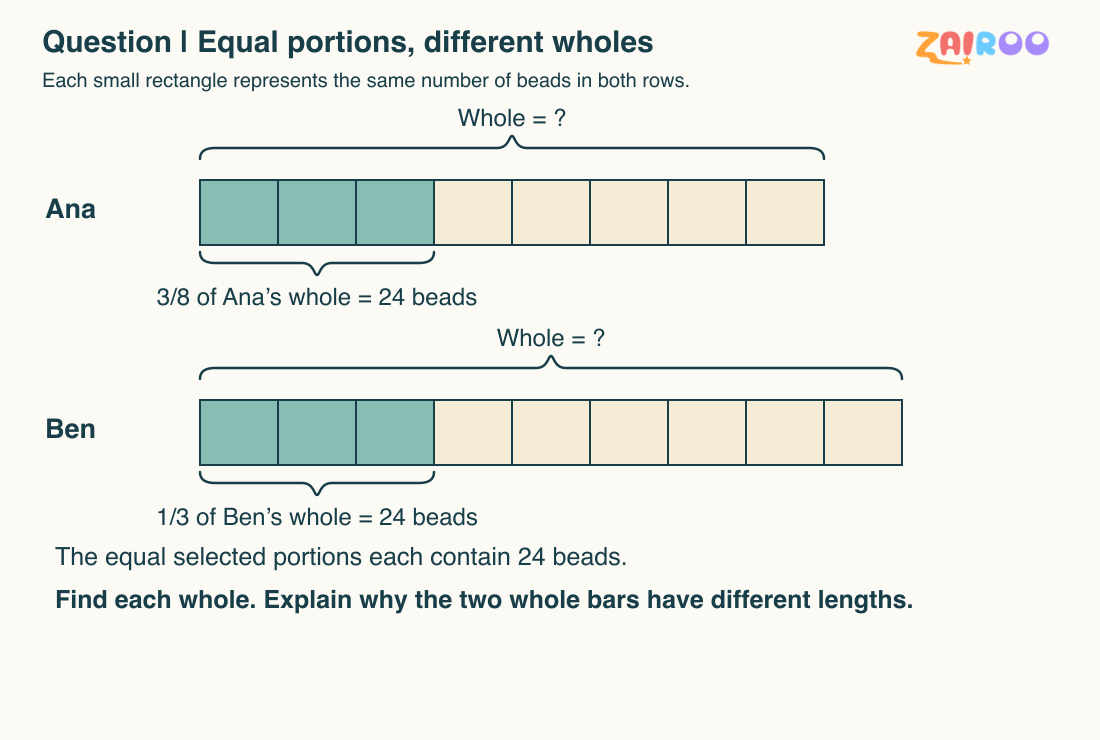
Each selected portion spans three common units. The whole bars contain different numbers of those units, so their total lengths differ.
Preview is a required maths check
Before showing or exporting the model, open Preview and compare the actual widths of corresponding units across both bars. Count eight units and nine units, then count each selected group of three. Check that both 24-bead braces cover three units, not a full bar. If scale or segmentation is inconsistent, correct or rebuild the model and preview again; do not use an inaccurate model in class.
Export the Bar Model as a PNG and inspect it at the size you will use. Labels must remain readable and the unit-width relationship must survive. Prepare a question view without totals and a separate solution view. When placing the PNG in a document, resize the whole image together rather than stretching one bar independently.
Worked solution
24 / 3 = 8 beads: value of one common unit.
8 x 8 = 64 beads: Ana's eight-unit whole.
9 x 8 = 72 beads: Ben's nine-unit whole.
64 + 72 = 136 beads: combined collection.
72 - 64 = 8 beads: Ben has one common unit more.
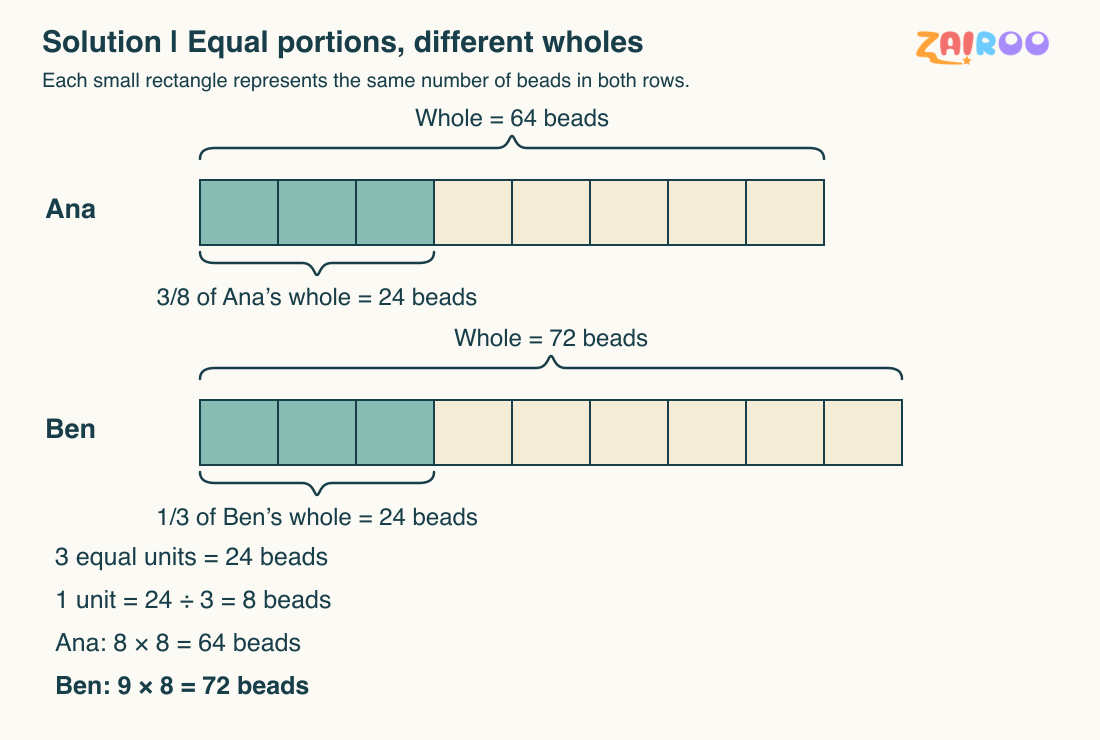
The common unit represents eight beads. Ana has eight such units and Ben has nine; the extra unit explains the difference between their totals.
Check the original conditions independently
64 / 8 = 8 beads: one eighth of Ana's collection.
8 x 3 = 24 beads: Ana's stated selected fraction.
72 / 3 = 24 beads: Ben's stated selected fraction.
Both selected quantities return 24, which checks the question rather than merely repeating the final addition. The P5 fractions guide supports careful identification of the whole. The P5 model-drawing guide supports equal-part, part-whole reasoning; formal ratio notation is not needed here.
Teacher questions and fresh retry
Ask: Why does Ben need nine common units? Which whole does each denominator describe? If the bars had equal total lengths, what false relationship would the picture suggest? Invite pupils to justify the three selected units before any division. If a pupil divides 24 by eight, ask whether 24 labels the whole collection or only its selected part. Have the pupil point to the brace and count the units underneath it. This makes the correction about meaning rather than about remembering which number to divide by.
Retry: Three eighths of Mei's stamps equal one third of Ravi's stamps. Each selected amount is 30 stamps. Use eight and nine common units again. Find both wholes, their total and the difference.
30 / 3 = 10 stamps: one common unit.
8 x 10 = 80 stamps: Mei's whole.
9 x 10 = 90 stamps: Ravi's whole.
80 + 90 = 170 stamps: total.
90 - 80 = 10 stamps: difference.
Preparation FAQ
Does equal selected amount mean equal whole? No: the selection occupies three of eight units in one whole and three of nine in the other. Where is educator access arranged? Email business@zairoo.ai for a Bar Model demo using your lesson brief. For families seeking homework support, the parent platform is a separate option, not educator demo access.