Start where the meaning changed
To review a fraction remainder problem, find the first step where your child used the wrong whole. A fraction of the money left is not a fraction of the original amount. Label those two quantities before asking for more calculation.
For families using Zairoo.Ai, keep a pencil-and-paper explanation beside the question. Your child's description of each amount matters more than how neatly the final answer is copied. Today's challenge suits P5 learners who can find fractions of quantities, divide into equal parts and work backwards from a known amount.
The challenge
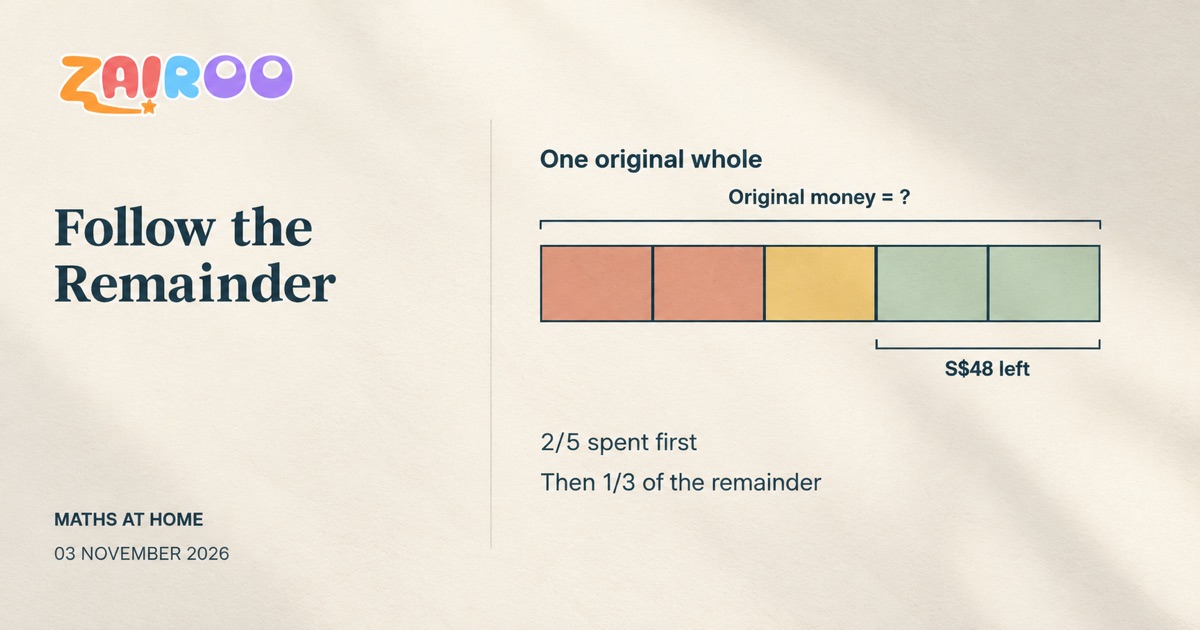
Hana spends 2/5 of her original money. She then spends 1/3 of the money remaining. She has S$48 left. How much money did she have originally, and how much did she spend on each occasion?
Ask your child to read the second sentence again before drawing. What does "remaining" refer to? It means the money after the first purchase. Do not begin by adding 2/5 and 1/3: those fractions refer to different quantities.
The P5 fractions guide offers relevant fraction groundwork. Pair it with the remainder and part-whole approaches in the P5 methods and model-drawing guide when choosing a visual explanation.
Visual model and step by step solution
Step 1 Divide the original whole into equal units
The original whole has 5 equal parts.
Use 1 small unit in each part.
5 x 1 = 5 units in the original whole.
First purchase: 2 x 1 = 2 units
Step 2 Use the remainder as the second whole
5 - 2 = 3 units remain.
3 / 3 = 1 unit in one equal part of the remainder.
Second purchase: 1 x 1 = 1 unit
3 - 1 = 2 units left.
Step 3 Find the value of one original unit
48 / 2 = S$24
Step 4 Find the original money and both purchases
Original money: 5 x 24 = S$120
First purchase: 2 x 24 = S$48
Second purchase: 1 x 24 = S$24
Answer: Original money = S$120. First purchase = S$48; second purchase = S$24.
Check against the question
120 - 48 = 72
72 - 24 = 48
Review one specific misconception
Suppose your child calculated 1/3 of S$120 for the second purchase. The arithmetic may be accurate, but the quantity is wrong. Circle the words "money remaining" and ask them to point to that amount on the bar.
A useful correction note is "Name the whole before finding its fraction." That gives your child something to do on the next problem. "Be more careful" does not identify the decision that needs changing.
Parent prompts that leave room to think
Before calculating, ask, "Which amount does each fraction describe?" During drawing, ask, "Where would you put the bracket for the money after the first purchase?" When checking, ask, "Can each spending amount satisfy the sentence it came from?"
Wait for your child to indicate a quantity before offering another prompt. If the bar becomes confusing, redraw the five equal sections cleanly rather than supplying the missing number.
Fresh retry with a worked solution
Leah spends 1/4 of her original money, then 2/3 of the remainder. She has S$30 left. Find her original money and both purchases.
Pause for an independent attempt before reading the model and solution.
Step 1 Divide the original whole into equal units
The original whole has 4 equal parts.
Use 1 small unit in each part.
4 x 1 = 4 units in the original whole.
First purchase: 1 x 1 = 1 units
Step 2 Use the remainder as the second whole
4 - 1 = 3 units remain.
3 / 3 = 1 unit in one equal part of the remainder.
Second purchase: 2 x 1 = 2 units
3 - 2 = 1 unit left.
Step 3 Find the value of one original unit
30 / 1 = S$30
Step 4 Find the original money and both purchases
Original money: 4 x 30 = S$120
First purchase: 1 x 30 = S$30
Second purchase: 2 x 30 = S$60
Answer: Original money = S$120. First purchase = S$30; second purchase = S$60.
Check against the question
120 - 30 = 90
90 - 60 = 30
A multi step extension
Mira spends 1/3 of her original money, then 2/5 of the remainder. She gives S$18 to her brother and has S$54 left. How much did she have at first, and how much did she spend on each purchase? The gift is a fixed amount, not another fraction.
Step 1 Divide the original whole into equal units
The original whole has 3 equal parts.
Use 5 small units in each part.
3 x 5 = 15 units in the original whole.
First purchase: 1 x 5 = 5 units
Step 2 Use the remainder as the second whole
15 - 5 = 10 units remain.
10 / 5 = 2 units in one equal part of the remainder.
Second purchase: 2 x 2 = 4 units
10 - 4 = 6 units left before the gift.
Step 3 Undo the fixed gift
54 + 18 = S$72
6 units represent S$72.
Step 4 Find the value of one original unit
72 / 6 = S$12
Step 5 Find the original money and both purchases
Original money: 15 x 12 = S$180
First purchase: 5 x 12 = S$60
Second purchase: 4 x 12 = S$48
Answer: Original money = S$180. First purchase = S$60; second purchase = S$48.
Check against the question
180 - 60 = 120
120 - 48 = 72
72 - 18 = 54
Extension retry with a worked solution
Spend 1/4 of the original money, then 1/3 of the remainder. Give away S$12 and finish with S$48. Find the original money and both purchases.
Try this independently before checking the solution.
Step 1 Divide the original whole into equal units
The original whole has 4 equal parts.
Use 1 small unit in each part.
4 x 1 = 4 units in the original whole.
First purchase: 1 x 1 = 1 units
Step 2 Use the remainder as the second whole
4 - 1 = 3 units remain.
3 / 3 = 1 unit in one equal part of the remainder.
Second purchase: 1 x 1 = 1 unit
3 - 1 = 2 units left before the gift.
Step 3 Undo the fixed gift
48 + 12 = S$60
2 units represent S$60.
Step 4 Find the value of one original unit
60 / 2 = S$30
Step 5 Find the original money and both purchases
Original money: 4 x 30 = S$120
First purchase: 1 x 30 = S$30
Second purchase: 1 x 30 = S$30
Answer: Original money = S$120. First purchase = S$30; second purchase = S$30.
Check against the question
120 - 30 = 90
90 - 30 = 60
60 - 12 = 48
FAQs
Must we use the bar method? No. A correct backwards explanation is fine; the bar helps keep each whole visible.
Does one wrong remainder question mean the entire topic is weak? No. Check whether the difficulty is identifying the whole, understanding equal parts or calculating.
Source note: These original challenges illustrate methods linked above; they are not official examination questions.
For your next practice session, use Zairoo.Ai alongside a labelled bar and ask your child to explain which whole each fraction uses.