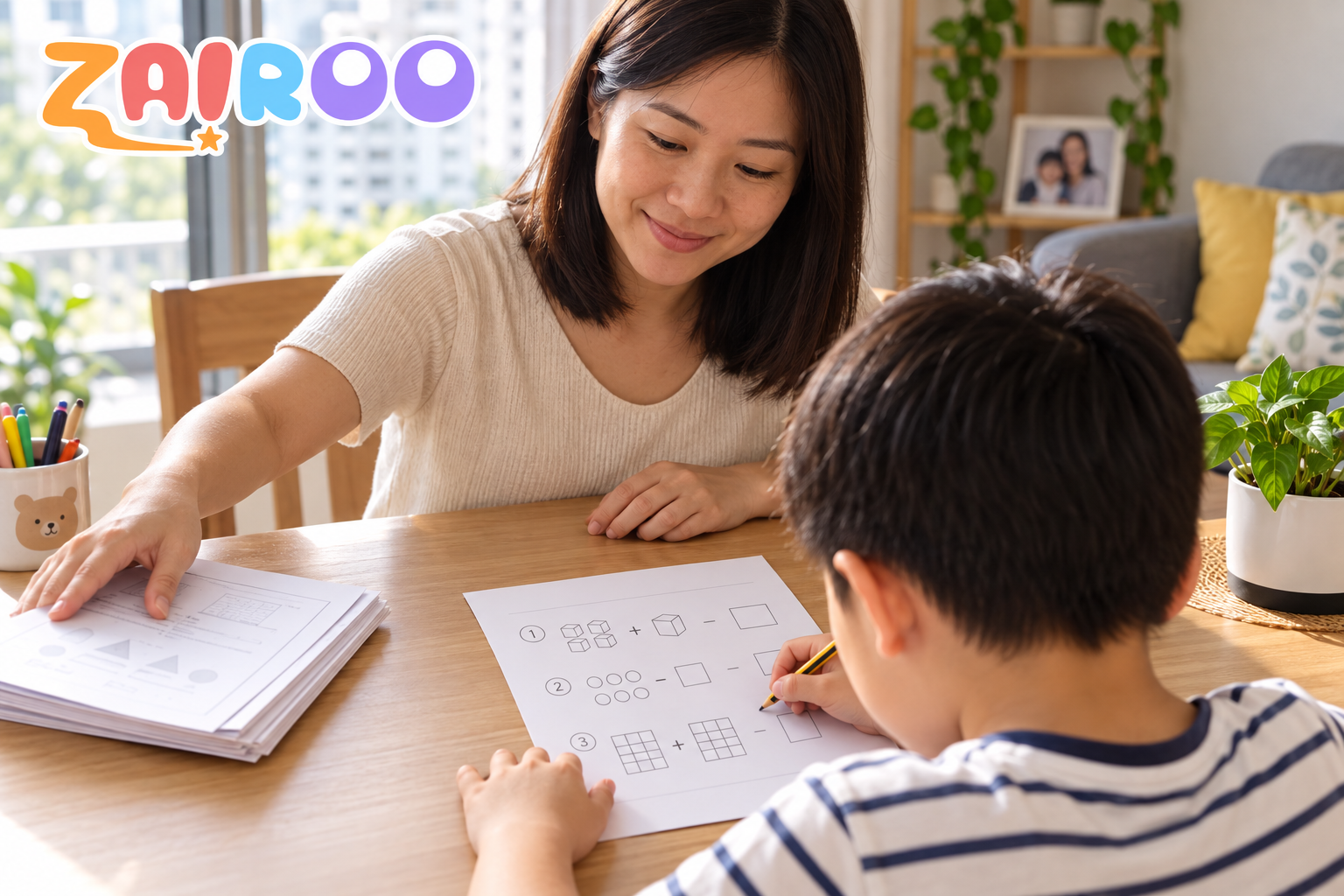
If your child has a school maths paper this week, choose one troublesome topic, revisit one instructive mistake and leave time for the child to explain a method back. Avoid adding a whole new stack of papers merely because the assessment is close.
The phrase 'exam week' can make a family feel that every spare minute should become another worksheet. That is not the only way to use a short window well.
Because school assessment dates vary, this guide is for families who actually have a school maths paper ahead. The same small-step review can also help when a paper has already come back.
Choose one useful target
Look at recent work and ask where your child is most likely to lose the method, not merely where they lost the most marks. Pick one topic or question type that can be practised with a clear first step. A targeted attempt gives the child something to understand; a random extra paper may only increase the pile.
If the child can already explain a method and apply it to a fresh example, there may be little value in repeating that same kind of question tonight. Leave the mastered work alone and protect the energy needed for the harder part.
Review one mistake without reliving the whole paper
Choose an error that teaches something. Ask, 'What were you trying to find?' and 'Where did your working change direction?' Then offer the smallest useful prompt. Let your child make the next move and explain why it fits.
Zairoo can support this kind of question-by-question review, but the principle works with a pencil too: one specific miss, one clearer method and one fresh attempt. It is not a promise about exam results.
Match October to your child's level
For Primary 3 to 5 families, use this exam-week approach only if a school paper is actually coming. Schools do not share one nationwide October assessment timetable. If the paper has already returned, turn the result into one next practice decision instead of treating it as a judgement on the child.
Primary 1 and 2 families can use the same calm practice routine without exam pressure: Singapore Ministry of Education says weighted assessments and exams for P1 and P2 were removed. For Primary 6, the national PSLE written papers have concluded by October, so the focus should be decompression and purposeful learning rather than last-minute PSLE preparation; see the SEAB 2026 PSLE dates.
Know what to leave alone
Leave aside a brand-new method that requires a long explanation, an extra full paper added only out of worry, and a difficult argument about how much your child 'should' know. None of these makes the next attempt clearer in a tense moment.
Finish with a question your child can answer: 'What is one step you understand better now?' Try a clearer next step with Zairoo if a guided prompt would make that step easier to see.
A focused fraction review at the right level
If equal parts are the missing idea, a Primary 2 starting check is 3/4 − 1/4. Remove one of three shaded quarters from the same whole: 2/4 remains, equal to 1/2. The denominator stays four because the parts are still quarters. Use the Primary 2 fractions guide if this foundation needs attention, even when an older child needs a brief revisit.
For the related-denominator work in the Primary 3 fractions guide, try 1/2 + 1/4. Rename 1/2 as 2/4, then add 2/4 + 1/4 = 3/4. Ask why both amounts must use the same-sized pieces. A fresh check is 5/6 − 1/3: rename 1/3 as 2/6, leaving 3/6 = 1/2. Stop after the child explains the method; choose an older child's next question from their actual classwork rather than treating these examples as a full P3–P5 revision set.
Exact questions parents can ask
"Which one question would make the method clearer tonight?"
"Can you explain why the parts are still quarters?"
"What is a sensible finish point for this session?"
Example and source notes
These illustrative examples address selected skills from the linked Zairoo guides; they are not official exam questions or a complete assessment. The MOE syllabus supports topic placement and the MOE assessment-policy page supports the P1/P2 assessment statement. Neither source establishes an outcome for Zairoo or a guarantee about school results.
References and further reading
How Zairoo primary maths practice works
Explore the parent practice routine, topic selection and progress information.