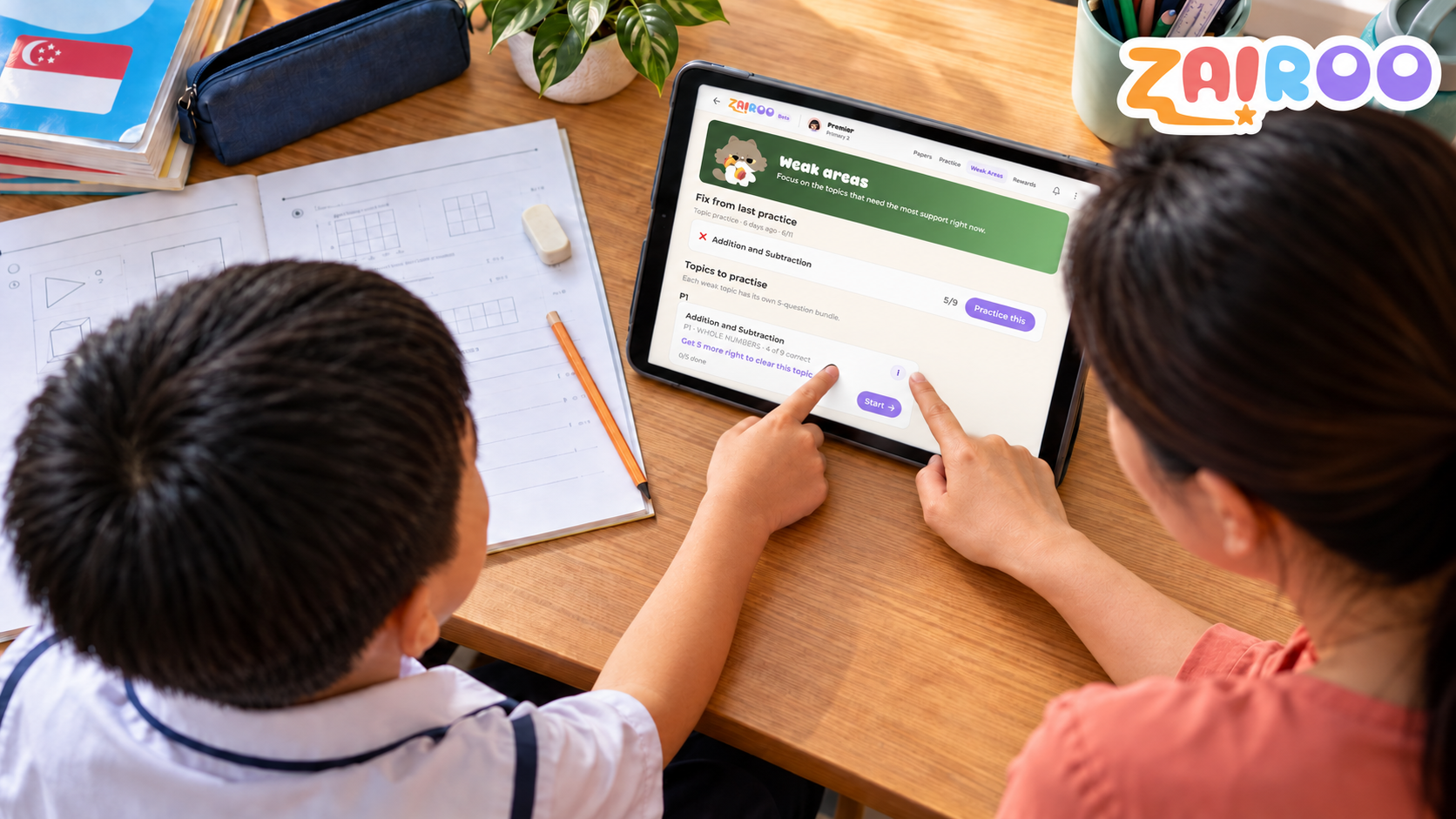
After ordinary practice, note one independently explained success, one repeated sticking point and one next task. A parent’s short observation record can guide the next session without turning a score into a label.
Record what the child actually did
Write the topic, the attempted method, the help given and the explanation afterwards. “Needed a prompt to regroup a hundred” is more useful than “weak at subtraction”. Keep independent work separate from an answer completed with adult help.
A Primary 2 example: regroup across a zero
For 604 − 278, regroup 604 as 5 hundreds, 9 tens and 14 ones. Subtract 8 ones from 14 ones to get 6 ones; 7 tens from 9 tens to get 2 tens; and 2 hundreds from 5 hundreds to get 3 hundreds. The result is 326. Check: 326 + 278 = 604.
If a child can subtract the ones but cannot explain where the 9 tens came from, revisit the regrouping with a place-value drawing. A successful final answer alone may conceal a copied step. Use the Primary 2 addition and subtraction guide.
Keep strength, difficulty and next step separate
- Strength: the child can explain which digit represents hundreds, tens and ones.
- Observed difficulty: exchanging one hundred and then one ten across a zero.
- Next task: draw the exchanges for 503 − 247, then calculate. The answer is 256; check with 256 + 247 = 503.
- Follow-up: try another suitable example on a later day and record whether a prompt was needed.
Avoid reading more into the record than it shows
Hesitation may reflect unfamiliar wording, tiredness, uncertainty or a method that needs teaching. These can overlap. Compare more than one attempt and ask the teacher about persistent difficulty instead of inferring a diagnosis.
When you have a worksheet report instead
For the separate supported worksheet workflow, read how to interpret worksheet analysis. Topic practice, parent observations and the dedicated worksheet analysis tool provide different kinds of information.
Sources and example notes
The MOE Primary Mathematics syllabus (October 2025) supports the topic-level references. These original practice examples are not official assessment questions.
The EEF mathematics guidance recommends using assessment to inform teaching. Its Key Stages 2–3 context is England; it does not establish Singapore levels or Zairoo outcomes.
Explore question guidance: Zairoo.
Want more support? Start with Zairoo’s free Basic plan for Singapore Primary 1–6 maths practice and step-by-step question guidance. Basic has usage limits. See the current plans and limits to compare Basic and Premium.
How Zairoo primary maths practice works
Explore the parent practice routine, topic selection and progress information.