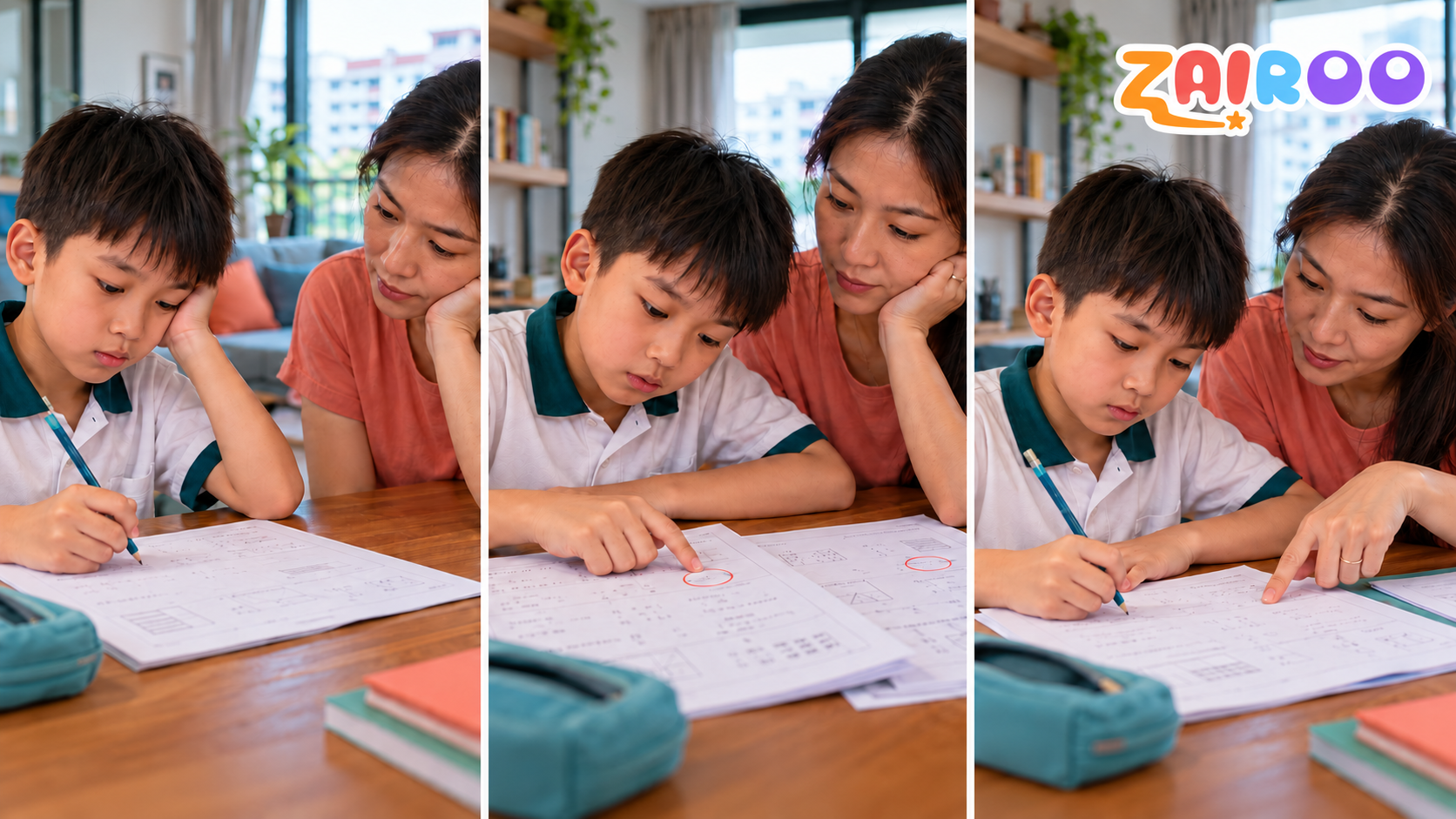
Pause and offer a smaller prompt when a child cannot identify the task, repeats an unexplained step, or asks for the answer before attempting it. These observations help choose support; they do not diagnose a learning difficulty.
1. The child cannot say what the question asks
Ask, “What do we need to find?” Let the child point, sketch or explain aloud. If the wording is unclear, read it together before choosing an operation. A child may understand the maths but need help interpreting this particular question.
2. The same step keeps going wrong
Compare the working across two or three attempts. Ask why that step was chosen. Separate an arithmetic slip from a misunderstanding of the relationship; a wrong answer alone cannot tell you which occurred.
3. The child waits for an answer before trying
Offer a starting point rather than filling in the calculation. For “Four bags contain six marbles each”, ask the child to draw four groups and label the amount in each. If that remains hard, model one group and let the child continue.
A Primary 3 example: make the groups visible
Four groups of six contain 4 × 6 = 24 marbles. Check by adding 6 + 6 + 6 + 6. Then ask for three groups of six: 3 × 6 = 18. Listen for the explanation of what each number represents, rather than accepting a copied calculation.
Use the Primary 3 multiplication and division guide for the next short attempt. For a child at another level, choose a familiar task from the Learning Hub.
Decide what to do next
- If the child can explain and retry, check the idea again later with a fresh example.
- If the wording remains unclear, practise interpreting one question together.
- If the method remains unclear, revisit the matching guide and discuss recurring difficulty with the teacher.
- If the child is tired or distressed, pause; extra worksheets need not be the next step.
Sources and example notes
The MOE Primary Mathematics syllabus (October 2025) supports the topic-level references. These original practice examples are not official assessment questions.
The EEF mathematics guidance recommends using assessment to inform teaching. Its Key Stages 2–3 context is England; it does not establish Singapore levels or Zairoo outcomes.
Explore question guidance: Zairoo.
Want more support? Start with Zairoo’s free Basic plan for Singapore Primary 1–6 maths practice and step-by-step question guidance. Basic has usage limits. See the current plans and limits to compare Basic and Premium.
How Zairoo primary maths practice works
Explore the parent practice routine, topic selection and progress information.